Points vs the alternatives: six kinds of loyalty program, and which one fits a Canadian restaurant or shop
Points, stamps, tiers, memberships, coalitions and instant dollar rewards, compared on when the customer feels it and what you pay before anyone returns.

- Published
- Reading time
- 11 minutes
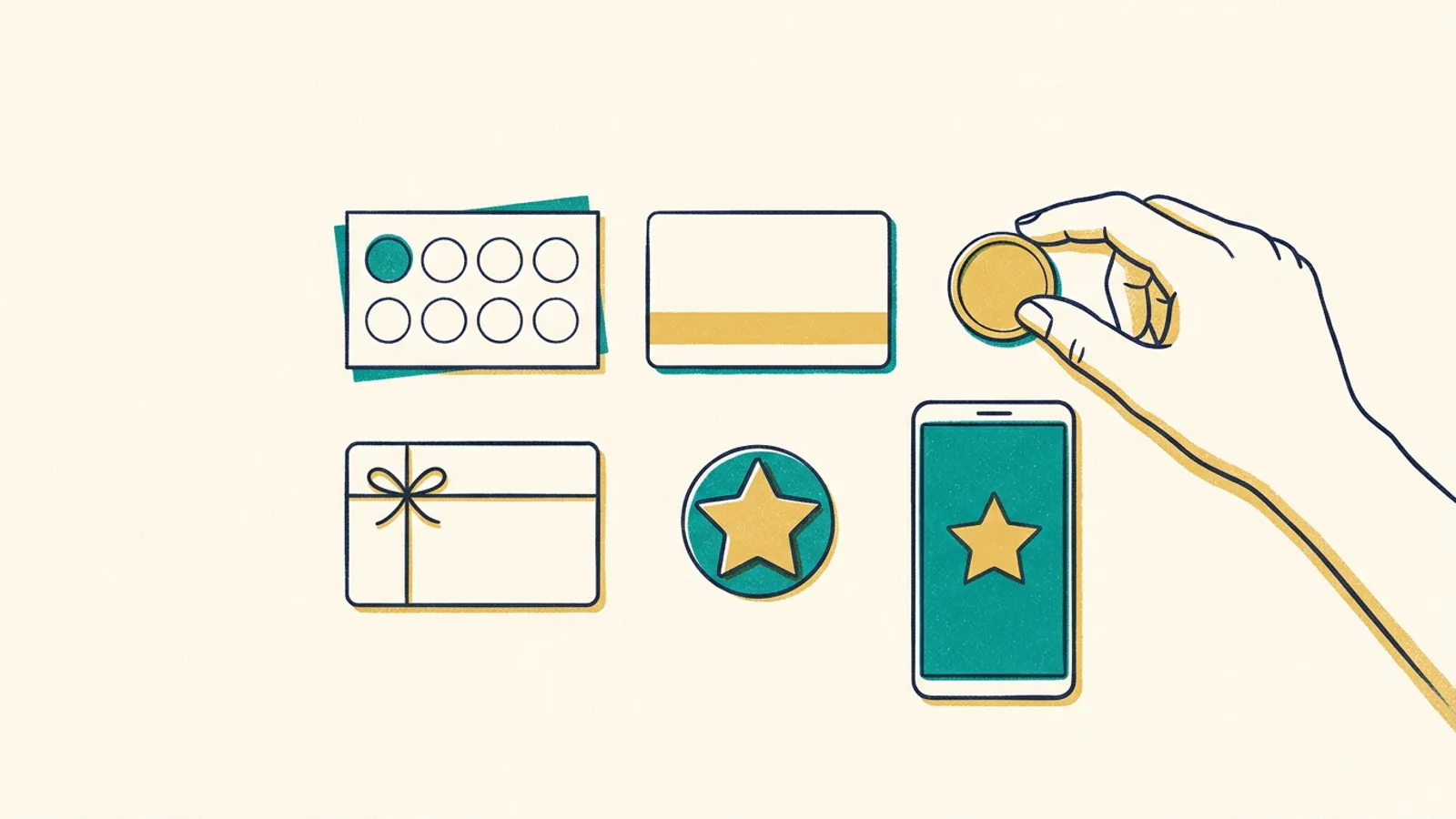
There are six kinds of loyalty program: points, stamps, tiers, paid memberships, coalitions and instant dollar rewards. A loyalty program is a promise to pay a customer for coming back; what differs is when the customer feels it and what you pay before anyone returns. Instant dollar rewards on trovy pay on visit one and cost only on the return.
The short version
| Model | When the customer feels it | What you pay, and when | Effort to run | What you learn | Sold by (prices from their own pages, October 6, 2026) | Best for |
|---|---|---|---|---|---|---|
| Points | At a threshold, weeks or months out | A monthly fee per location or a plan tier, whether anyone redeems (Square Loyalty: $60 to $140 a month by loyalty visits) | Earn rules, thresholds, marketing | Spend by member, for those who joined | Square Loyalty, Lightspeed, Toast, Kangaroo, Smile.io | A chain with a marketing team, or a weekly shop |
| Stamp cards | On the tenth visit | Printing, or $25 to $199 a month on the apps' pages, plus the free item | Stamp or scan | Nothing, or a name in an app | Paper; Loopy Loyalty; Stamp Me | A $5 product bought weekly |
| Tiers | When they cross a line, usually once a year | Built into a points plan (Smile.io on its $199 Growth plan; Lightspeed's loyalty) | Define the tiers and the perks | Who your top spenders are | Smile.io, Lightspeed, Kangaroo | A brand with enough regulars to rank |
| Paid memberships | On day one, because they paid for it | Nothing; the customer pays you | A benefits program worth the fee, every month | Who will pay to belong | Costco, Amazon Prime | A big box, or a subscription product |
| Coalitions | At a threshold, across many brands | Negotiated enterprise terms | A partnership team | What the program chooses to share | Scene+, Aeroplan, Blue Rewards (formerly Air Miles) | National chains; closed to independents |
| Instant dollar rewards | Seconds after paying, by text, usable on the next visit | $5 to start, covering your first 5 redemption visits or your first month, whichever comes first; then 2.5% of the return visit and five cents a text | Four numbers, set once | A member by phone number, with consent | trovy | Any counter that wants the second visit sooner |
Points: the default, and the slowest
The honest case: points are the model everyone understands, they scale, and the POS vendors sell them inside the till. Square Loyalty in Canada charges $60, $100 or $140 a month per location, by the number of loyalty visits. It awards points per visit, per amount spent, per item or by category. Lightspeed, Toast, Kangaroo and Smile.io each sell a version.
The cost is the delay. PC Optimum, the country's largest program, converts 10,000 points to $10 under its own terms (opened October 4, 2026). Bond's 2026 Canadian report found Canadians in an average of 15 loyalty programs, sitting on an estimated $13 to 15 billion in unredeemed points. 28% redeem once a year or less, and 60% say they prefer small or medium rewards over saving for large ones. A points balance is a promise the customer has to remember.
One rule to know: in Quebec, loyalty points cannot expire on a date or after a set period. They can expire only after at least a year of inactivity, with 30 to 60 days' notice. Elsewhere the terms are the program's own.
Where it fits: a chain with a marketing team, a weekly grocery shop, and customers who will sit through the wait.
Stamp cards: simple, and finished by one in five
The honest case: nothing is simpler. A paper card costs the printer. Loopy Loyalty sells a wallet-pass version from $25 a month for one location and $95 for ten. Stamp Me sells an app version at $49, $79 and $199 a month, in US dollars by default on its pricing page; Loopy's page shows no currency. A regular who comes four times a week finishes a ten-stamp card in under three weeks.
The research says the rest. In Nunes and Dreze's 2006 car-wash experiment, 19% of customers finished a plain eight-stamp card and 34% finished a ten-stamp card that came with two stamps already filled. Kivetz, Urminsky and Zheng, in the Journal of Marketing Research the same year, gave cafe customers either a plain ten-stamp card or a twelve-stamp card with two bonus stamps. The second group finished in 12.7 days against 15.6, "nearly three days or 20% faster," and customers bought more often the closer they got to the reward.
Where it fits: a $5 product bought weekly, with a head start on the card. The format is not the problem. The wait to the tenth stamp is. trovy's own version is Streaks, its modern punch card: something on every visit, starting right away, set up with a trovy expert.
Tiers: status for the few
The honest case: tiers give your best customers a reason to stay your best customers. Smile.io lists its VIP program on the Growth plan at $199 a month; Lightspeed's loyalty lets you "add as many tiers as you want." The research on status, Drèze and Nunes in 2009, is widely cited; the paper would not open for this check. It found that adding a lower tier raises the standing of the people above it, and that letting too many into the top tier dilutes it.
Where it stops: a tier needs enough regulars to rank, a year to earn, and perks worth ranking for. For a counter with 300 members, Gold is a label. Where it fits: a brand with thousands of members and a reason to sort them.
Paid memberships: the customer pays first
The honest case: the strongest loyalty model in retail is the one the customer pays for. Costco's annual fee and Amazon Prime's are the examples everyone knows (both sites would not open for this check, so no figure is quoted here; the model is the point). A paid member has already decided to come back.
Why an independent rarely can: the fee has to buy something the customer values more than the fee, every month. A single shop seldom has the range to deliver it. The nearest an independent gets is a subscription product, a coffee pass or a bread share, which is a product rather than a loyalty program. Where it fits: a big box, or a product people buy every week.
Coalitions: closed to independents
The honest case: one card, many brands, and the customer earns everywhere. Scene+ lists Sobeys, Foodland, Shell, Home Hardware, Cineplex and Recipe Unlimited's restaurants among its partners. Aeroplan runs the airline version. Air Miles, the oldest, now redirects its site to bluerewards.ca; the transition to BMO's Blue Rewards was reported in June 2026.
Where it stops: Scene+'s partner page publishes no way for a local business to join, no application and no contact for one. The same is true of the others; the coalition article in this series goes through them. The coalition is a model for national chains with partnership teams. Where it fits: a chain large enough to negotiate.
Instant dollar rewards: paid on visit one, costing you only on visit two
Loyalty shouldn't take years. trovy treats every customer like a regular from the first visit: a reward the moment they pay, a branded text, a reason to come back. The model: the customer pays, and a dollar reward lands by text seconds later, usable on their next visit above a minimum, with a date on it. The research on timing is why it works. In experiments published in the Journal of Personality and Social Psychology (Woolley and Fishbach, 2018), an immediate bonus led to a 35% increase in the number of people who kept going after the reward was removed. A larger but delayed reward managed 19%. The reward that lands now changes the habit. The balance that pays later rarely does.
This is the model trovy runs. It works through the POS you already have, and the customer's phone number becomes a member record on your own list, with consent handled at the join. Four numbers, set once:
| Parameter | What it does | Cafe, $6 ticket | Boutique, $120 basket |
|---|---|---|---|
| Earn rate | Share of the purchase that becomes a reward | 10% | 10% |
| Cap | The most one visit can earn | $2 | $15 |
| Minimum spend | What the return purchase has to reach | $6 | $100 |
| Expiry | How long the reward lasts | 30 days | 45 days |
What it costs: start for $5, everything included for your first 5 redemption visits or your first month, whichever comes first. Then you pay only on repeat sales: 2.5% of what the member spends on the visit where they redeem, after the reward comes off, plus five cents for each text you send. Rewards expire, 30 to 60 days out, and the text says so.
A $6 coffee: the customer earns 60 cents, comes back within the month, and 60 cents comes off a $6 purchase. You collect $5.40 and pay about 24 cents (14 cents plus two texts at five cents each). Across ten visits that is about $6 in rewards, the same as the free tenth coffee on a stamp card. The difference: it started on day one, and you know who the customer is. Set that against a $60-a-month points module at a cafe with 300 loyalty visits a month: 20 cents a visit, whether anyone redeems or not.
Which loyalty program fits which business?
- A $5 to $15 ticket bought weekly (coffee, lunch, a bakery): stamps or an instant reward. Stamps if you want paper and no data; an instant reward if you want the first visit to count and a list you can text.
- A $40 to $80 ticket a few times a month (dinner, a pharmacy, a barber): points pay too slowly to notice. An instant reward on the first visit, with a 30-day expiry, matches the rhythm.
- A $100-plus basket a few times a year (clothing, gifts, home): tiers if you have thousands of members; an instant reward with a 45-day expiry and a $15 cap if you have hundreds.
- A chain with a marketing team: points with tiers, or a coalition if you are large enough to negotiate one.
- A big box or a subscription product: a paid membership.
- Any counter that cannot carry a monthly fee: the only model that costs nothing until it works is the one that pays on redemption.
Points and stamps ask the customer to wait to be treated like a regular. An instant reward on trovy treats them like one on day one, and everything else in the comparison follows from that.
Related reading: PC Optimum vs local instant rewards | trovy, Scene+ is not for your shop. What is? | trovy, The ten-stamp punch card vs a reward on visit one | trovy, Square Loyalty vs instant rewards for Canadian shops | trovy.
Sources
- Square, Loyalty for Canada
- The Wise Marketer, 2026 Bond Loyalty Report shows Canadians are sitting on $13 to 15 billion in unredeemed loyalty points
- Bond, 2026 Loyalty Report Canadian release (GlobeNewswire, May 19, 2026)
- Stamp Me, Pricing
- Loopy Loyalty, Pricing
- Nunes and Dreze, The Endowed Progress Effect, Journal of Consumer Research 32(4), 2006
- Kivetz, Urminsky and Zheng, The Goal-Gradient Hypothesis Resurrected, Journal of Marketing Research 43 (2006), full text
- Smile.io, Pricing
- Lightspeed, Retail loyalty
- Scotiabank, Scene+ partners
- Air Miles (airmiles.ca, now redirecting to bluerewards.ca)
- Phys.org, summary of Woolley and Fishbach, It's About Time: Earlier Rewards Increase Intrinsic Motivation (Journal of Personality and Social Psychology, 2018)
- Office de la protection du consommateur (Quebec), Rewards programs: expiry
- PC Optimum (checked October 4, 2026 for the PC Optimum article; renders no text to automated tools)
Frequently asked questions
Points: PC Optimum, Scene+, and the module inside most POS systems. Bond's 2026 report counts Canadians in 15 programs on average, most of them points, with $13 to 15 billion unredeemed.
Rarely on their own. Points pay at a threshold weeks away, and 28% of members redeem once a year or less (Bond, 2026). A reward the guest can feel on visit one, with a date on it, matches how often people eat out.
From a printed card to $140 a month per location. On their own pages: Square Loyalty is $60 to $140 by loyalty visits, Loopy Loyalty $25 to $95, Stamp Me $49 to $199 in US dollars, and Smile.io's VIP tiers sit on its $199 plan. An instant reward on trovy has no monthly fee; you pay 2.5% of the redemption visit plus five cents a text.
One that ranks members (Silver, Gold) by spend and gives the top tiers perks. Smile.io lists it on its $199 plan and Lightspeed lets you add unlimited tiers. It needs enough members to rank.
Not through any published route. Scene+'s partner page lists national chains and no application for a local business.
A paper stamp card, if you want no data. If you want a list and a measurable repeat rate, an instant reward set with four numbers once, which trovy runs through the POS you already have.