Why constant sales train your customers to wait: markdowns vs instant rewards for Canadian clothing retailers
Fashion retailers spend 20% to 50% of net sales on markdowns, and every sale teaches customers to wait. The cost, and what instant rewards do instead.

- Published
- Reading time
- 8 minutes
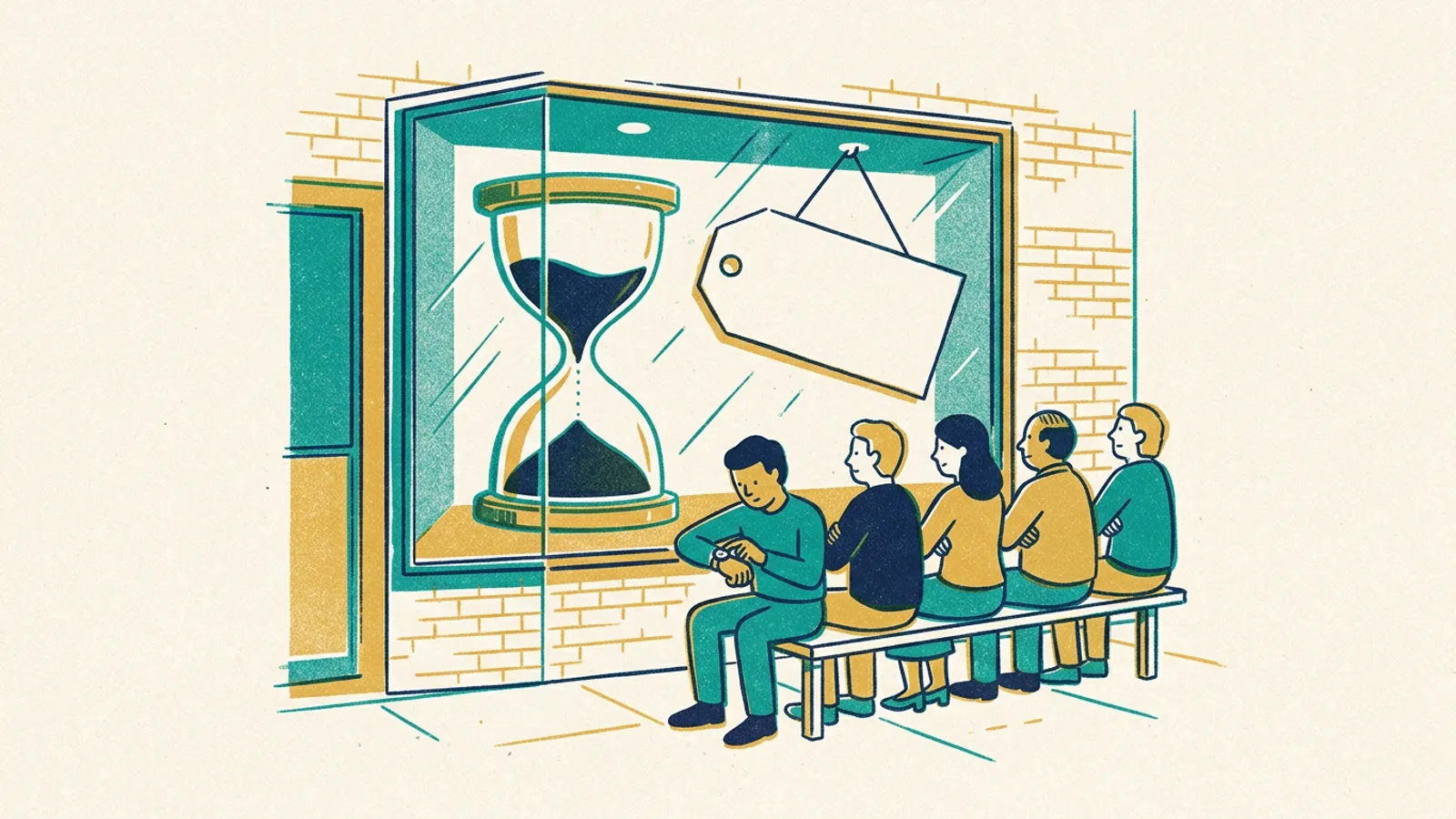
Constant markdowns are the most expensive loyalty program a clothing store can run. Fashion retailers spend 20% to 50% of net sales on them, and every sale week teaches the customer who would have paid full price to wait. An instant reward on trovy costs less, goes only to the customer who comes back, and keeps markdowns for real clearance.
The short version
| End-of-season markdown | Instant rewards on trovy | |
|---|---|---|
| Who gets it | Everyone who buys that week, full-price loyalists included | Only the customer who comes back and spends above your minimum |
| What it costs | 20% to 50% of net sales a year across the industry (Bain) | A capped reward on the return visit, plus 2.5% of that visit and five cents a text |
| When you pay | Today, off the top of the sale | On the second visit, after the first was paid in full |
| What the customer learns | Wait, and the price drops | Come back, and the reward is waiting |
| What you learn | Nothing; the sale is anonymous | Who came back, when, and what they spent |
| Best for | Clearing stock that is genuinely done | Any customer you want to see again |
When a markdown still makes sense
Markdowns are a tool, not a sin. They do one job well: turning stock that is finished into revenue before it costs you shelf space. Keep them for that.
- Real clearance. The last sizes of a line that will not come back next season. Price them to move and be done.
- Mistakes. The buy that did not land. Every shop has one a season, and clearing it quickly is good discipline.
- Season turns. Winter coats in March. The customer who buys a coat in March at 40% off was never going to pay full price in November.
The problem is not the markdown. It is the markdown as the only retention lever: the permanent sale rack, the monthly promo email, the Black Friday to Boxing Day stretch where full price stops existing. That is when a tool becomes a habit, and your customers learn it faster than you do.
What does a markdown really cost?
Start with the industry number. Bain's work on soft-goods retail found a typical fashion retailer spends 20% to 50% of net sales on markdowns, including 5% to 20% of net sales on temporary promotions. That analysis dates from 2021 and is still the benchmark most often cited. In Canada the discount rate keeps creeping. Salesforce's Shopping Index put the average online discount at 16% in the first quarter of 2025, up from 15% a year earlier. Average Black Friday discounting hit 28% in 2025, up from 27%.
Now one item. A $150 jacket at 30% off is $45 off. Not $45 off for the one customer you needed to win. It is $45 off for everyone who buys it that week, including the regular who paid full price for the same brand in September and would have again. To make the same revenue on that jacket you now need to sell 14 instead of 10, and more than that to make the same margin.
Compare the reward. The same customer pays $150 today. A few seconds later a text lands: $15 earned, good for 45 days on a purchase of $100 or more. They come back and spend $120 on a sweater. The $15 comes off, you collect $105, and you pay about $2.75 to trovy, which is 2.5% of the $105 plus two texts. Two full-price sales, one of them nudged, for about $18 all in. The markdown spent $45 on one sale and asked nothing in return.
And it spent it in the wrong place. The sale discount rewards timing. The instant reward rewards returning.
Who does the markdown train?
Shoppers learn. Salesforce's read on the 2025 holiday season, reported by Retail Insider in September 2026, says years of Black Friday promotions have "conditioned consumers to expect substantial discounts". It got to the point where the Tuesday after Cyber Monday carried better average discounts than Black Friday itself, because shoppers held out. Industry analysts put it plainly: promotions used poorly "train shoppers to wait for discounts and compress category value over time".
The 2026 Canadian shopper is primed for it. In Retail Council of Canada's spring 2026 Shopper Sentiment Study, price is the top driver across every kind of shopping trip. Salesforce's holiday outlook finds 56% of Canadian consumers concentrating spending on essentials, 51% pulling back on splurges and 35% trading down to cheaper products. Clothing store sales rose 3.1% in June 2026 and fell 1.2% in July, according to Statistics Canada. These customers are watching for the price to drop, because you have shown them it will.
Points programs do not fix this. Canadians are sitting on an estimated $13 to 15 billion in unredeemed points, and 28% of members redeem once a year or less. Sixty percent say they prefer small or medium rewards over saving for something big, up 20 points since 2018 (Bond Loyalty Report, 2026). The research on motivation agrees. In a series of experiments published in the Journal of Personality and Social Psychology, people given a reward immediately rather than later were more motivated. They kept going even after the reward stopped (Woolley and Fishbach, 2018). The reward that lands now changes behaviour. The one that arrives next season, or after months of points, does not.
What instant rewards do instead
Loyalty shouldn't take years. trovy treats every customer like a regular from the first visit: a reward the moment they pay, a branded text, a reason to come back. trovy works through the POS you already run. A customer pays, and seconds later a text lands: "You earned $15 at [your shop]. Use it on your next purchase of $100 or more by November 14." Their phone number becomes a member record on your own list, with consent handled at the join. When they come back and spend the minimum, the reward comes off. Rewards expire, 30 to 60 days out, and the text says so. That date is the return visit.
Four numbers, set once:
| Parameter | What it does | A clothing boutique, $150 average basket |
|---|---|---|
| Earn rate | Share of the purchase that becomes a reward | 10% |
| Cap | The most one visit can earn | $15 |
| Minimum spend | What the return purchase has to reach | $100 |
| Expiry | How long the reward lasts | 45 days |
The cap and the minimum are the margin protection. Nobody earns more than $15 on a visit, and nobody redeems on a $20 pair of socks. The expiry is the calendar: 45 days matches how often a regular comes back to a boutique, long enough to be fair and short enough to prompt.
What it costs: start for $5, everything included for your first 5 redemption visits or your first month, whichever comes first. Then you pay only on repeat sales: 2.5% of what the customer spends on the visit where they redeem, after the reward comes off, plus five cents for each text you send.
Markdowns go back to being markdowns: a clearance tool you reach for on purpose, twice a year, on stock that is done. Full price becomes normal again, because the reward, not the sale, is the reason to come back. You are not discounting to discount. You are rewarding the customers who actually come back.
Related reading: Square Loyalty vs instant rewards for Canadian shops | trovy, Instagram ads vs your own members: rented vs owned | trovy, Rising costs: 3 options for restaurants and shops | trovy.
Sources
- Bain & Company, Curing the Discount Disease in Soft Goods Retail (June 2021)
- Channel Life Canada, Canadian online sales down as shoppers seek value and discounts (Salesforce Shopping Index, Q1 2025)
- Retail Insider, Canadian Black Friday sales rise 6% (Salesforce data, Dec 1 2025)
- Retail Insider, Canadian retailers enter holiday 2026 with spending momentum and price-sensitive shoppers (Sept 1 2026)
- Retail Council of Canada, Canadian Shopper Sentiment Study (spring 2026)
- Statistics Canada, Retail trade, June 2026 (Aug 21 2026)
- Statistics Canada, Retail trade, July 2026 (Sept 24 2026)
- Bond Brand Loyalty, Canadians are rethinking loyalty as everyday rewards take priority (2026 Bond Loyalty Report, May 19 2026)
- Consultancy.uk, Promoting smarter, not harder, can make the difference with discounting (SKIM)
- Phys.org summary of Woolley and Fishbach, It's About Time: Earlier Rewards Increase Intrinsic Motivation (Journal of Personality and Social Psychology, 2018)
Frequently asked questions
Yes. Salesforce's read on the 2025 holiday season found years of Black Friday promotions have conditioned shoppers to expect deep discounts. The Tuesday after Cyber Monday carried better average discounts than Black Friday as shoppers held out. Every predictable sale teaches the full-price customer to wait.
Bain's benchmark is 20% to 50% of net sales, including 5% to 20% on temporary promotions. Canadian online discount rates averaged 16% in early 2025 and 28% on Black Friday 2025, according to Salesforce data.
One the customer feels on the first visit. On trovy, a boutique with a $150 average basket typically runs a 10% instant reward capped at $15, redeemable on a purchase of $100 or more within 45 days. It costs nothing until the customer comes back.
Rarely. Canadians hold an estimated $13 to 15 billion in unredeemed points, 28% of members redeem once a year or less, and the big coalition programs have no sign-up for an independent shop. A dollar reward by text is understood instantly and used.
Start for $5, everything included for your first 5 redemption visits or your first month, whichever comes first. Then 2.5% of the purchase on which a member redeems, after the reward comes off, plus five cents per text. There is no setup fee and no monthly fee.
No. Keep markdowns for genuine clearance: last sizes, the buy that missed, the season turn. Drop the permanent sale rack and the monthly promo, and let the reward do the retention work.