Buy 9, get 1: why the tenth stamp rarely comes, and what a reward on the first visit does instead
Most ten-stamp punch cards are never finished: one field study found 19% completed. Why the wait is the problem, and what a reward on visit one does instead.

- Published
- Reading time
- 9 minutes
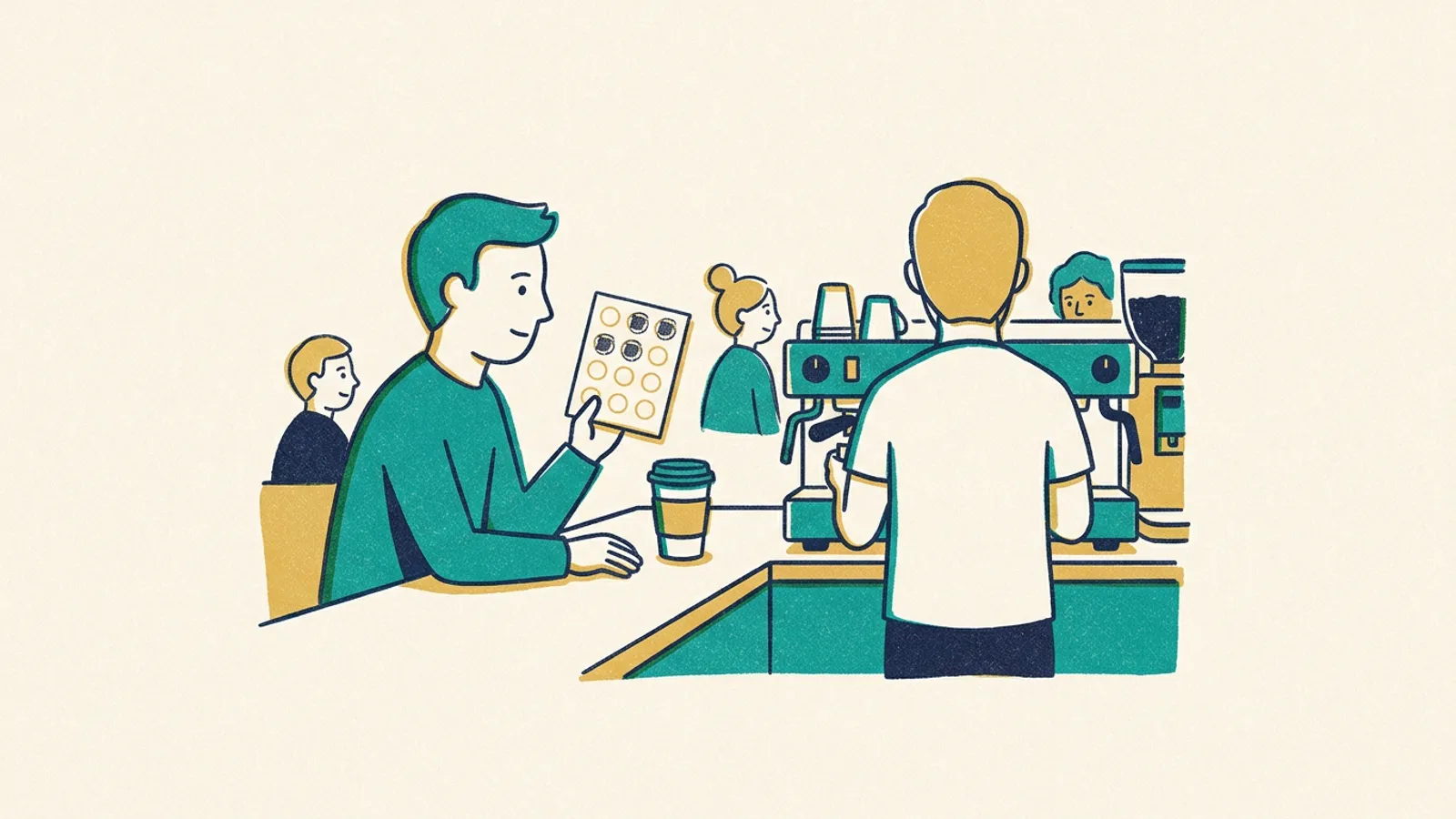
A ten-stamp punch card pays on visit ten, so the first nine visits earn nothing a customer can feel. Most cards never get there: a 2006 field experiment found 19% completed. The card is not the problem; the wait is. A first-visit reward by text, on trovy, removes the wait: a regular from day one, and someone you can reach.
The tenth-visit problem
The best evidence on punch cards is twenty years old and still the best. In a field experiment published in the Journal of Consumer Research (Nunes and Dreze, 2006), 300 car-wash customers were given loyalty cards. Half got a card needing eight stamps. Half got a card needing ten, with two already stamped. Same eight washes to a free one. Over nine months, 34% of the pre-stamped group finished their card and 19% of the other group did.
Two things follow. The first is that most people never finish a punch card at all: fewer than one in five, on a product people buy every few weeks. The second is the mechanism the authors named. A task that feels already begun gets finished; one that feels not yet started gets abandoned. The ordinary ten-stamp card starts at zero, every time.
A stamp-card vendor's own 2026 analysis of 23,296 stamps across 1,013 businesses points the same way. Completion fell from 11.4% when the expected wait to finish was two to four weeks to under 1% at 32 weeks or more. That is vendor data, not peer-reviewed, but the direction matches.
And nobody is short of cards. Bond's 2026 Canadian report has Canadians in an average of 15 loyalty programs. It finds 28% of members redeeming once a year or less and $13 to 15 billion in points sitting unredeemed.
The short version
| Ten-stamp punch card (paper) | Stamp app (Stamp Me, Loopy Loyalty) | Instant rewards on trovy | |
|---|---|---|---|
| When the customer feels it | Visit ten | Visit ten, on a phone | Visit one, by text, usable on visit two |
| What you learn about them | Nothing | A name in an app, if they joined | A member record on your own list, with consent |
| What it costs you | Printing and the free item | $25 to $199 a month on the vendors' pages, plus the free item | $5 to start, covering your first 5 redemption visits or your first month, whichever comes first; then 2.5% of that visit and five cents a text |
| What the customer carries | A card that gets lost | An app or a wallet pass | Nothing; the phone number is the account |
| What you do at the counter | Stamp it | Scan it | Nothing; it runs through your POS |
| Best for | A tiny shop that wants no technology at all | A cafe that wants the familiar card without paper | Any counter that wants the second visit sooner and a list it owns |
What do the stamp apps charge?
All figures from the vendors' own pricing pages, opened October 4, 2026.
| App | Price | How the customer joins | Where the card lives |
|---|---|---|---|
| Stamp Me | Lite $49, Pro $79, Elite $199 a month (US dollars by default on its page; a Canadian-dollar toggle exists); two programs included, then a $15 one-time setup fee per extra | Searches for your business in the Stamp Me app or scans a QR code | The Stamp Me app, with an optional save to Apple or Google Wallet |
| Loopy Loyalty | Starter $25, Growth $69, Ultimate $95 a month, as listed on its FAQ | Adds the card to Apple Wallet or Google Wallet; no app and no account | The phone's wallet; you stamp by scanning a QR code or from the dashboard |
| Square Loyalty (Canada) | From $60 a month per location | Phone number at the Square till | Square's system: points per visit, per dollar or per item; no stamp-card format is listed |
Loopy's wallet-pass design is the kindest of the three for a customer. It still pays on visit ten, and the monthly fee runs whether anyone finishes a card or not.
When does a punch card still work?
- When the product is bought weekly and costs the same every time. A daily coffee or a weekly bagel run gets to ten stamps. The car-wash study still found most people did not, but a regular who comes four times a week will.
- When you want zero technology. A paper card costs the printer and nothing else. If your till is a cash drawer, this is the only program that fits.
- When the free item is the whole point. A free tenth coffee is a clean promise, and some customers like the ritual of the stamp.
The format works when the reward comes early. A card that pays something on the first stamp, or that starts with two stamps already filled, is a different product from the ten-stamp card, and the research above says so. trovy's own version is Streaks, its modern punch card: something on every visit, starting right away, set up with a trovy expert.
The limits of the ten-stamp card are the same in every case: no data, no way to reach the customer, and a reward most people never see.
The cafe and the shop, worked through
A $5 coffee. Buy nine, get one. The reward is worth $5 and arrives on the tenth visit. A customer who comes twice a week finishes in five weeks. A customer who comes twice a month takes five months, and the card is in a drawer by then. The cafe learns nothing about either of them.
On trovy, the same cafe sets a 10% reward with a $2 cap, a $5 minimum and a 30-day expiry. The customer earns 50 cents on the first coffee, by text, and uses it within a month. Across ten visits that is about $5 in rewards, the same as the free coffee. The difference: it started on day one, and it cost about 20 cents in fees per redemption. Every one of those customers is now a member on the cafe's list who can be texted when Tuesday mornings are slow.
A $100 basket. A candle shop runs a stamp card: ten purchases, the eleventh item free. At a visit every six weeks, the card completes in fifteen months. It never completes.
On trovy, the shop runs 10% capped at $15, a $60 minimum, 45 days. The customer earns $10 on the first $100, by text, and comes back within six weeks for a $75 purchase with $10 off. The shop paid $10 plus about $2 in fees for a visit that happened, and knows who made it.
Rewards on trovy expire, 30 to 60 days out, and the text says so. That date is the difference between a card in a drawer and a visit on the calendar.
What instant rewards do instead
Loyalty shouldn't take years. trovy treats every customer like a regular from the first visit: a reward the moment they pay, a branded text, a reason to come back. trovy works through the POS you already run. A customer pays, and seconds later a text lands: "You earned $10 at [your shop]. Use it on your next purchase of $60 or more by November 18." Their phone number becomes a member record on your own list, with consent handled at the join. When they come back and spend the minimum, the reward comes off. Nothing to carry, nothing to stamp.
Four numbers, set once:
| Parameter | What it does | Cafe, $5 coffee | Specialty shop, $100 basket |
|---|---|---|---|
| Earn rate | Share of the purchase that becomes a reward | 10% | 10% |
| Cap | The most one visit can earn | $2 | $15 |
| Minimum spend | What the return purchase has to reach | $5 | $60 |
| Expiry | How long the reward lasts | 30 days | 45 days |
What it costs: start for $5, everything included for your first 5 redemption visits or your first month, whichever comes first. Then you pay only on repeat sales: 2.5% of what the customer spends on the visit where they redeem, after the reward comes off, plus five cents for each text you send.
The research on motivation backs the timing. In experiments published in the Journal of Personality and Social Psychology (Woolley and Fishbach, 2018), an immediate bonus led to a 35% increase in the number of people who kept going after the reward was removed, where a larger but delayed reward managed 19%. In a related experiment, an immediate bonus beat a delayed one by almost 20% on the same measure. The reward that lands now is the one that changes the habit. The tenth stamp rarely does.
Related reading: POS loyalty add-ons vs instant rewards | trovy, Discount vs reward for restaurants: the second visit | trovy, Points vs the alternatives: six loyalty models | trovy.
Sources
- Nunes and Dreze, The Endowed Progress Effect: How Artificial Advancement Increases Effort, Journal of Consumer Research 32(4), March 2006
- Silicon Canals, summary of the car-wash loyalty card experiment
- FaveCard, Loyalty card completion rate study, 2026 (vendor data)
- The Wise Marketer, 2026 Bond Loyalty Report shows Canadians are sitting on $13 to 15 billion in unredeemed loyalty points
- Stamp Me, pricing
- Stamp Me, home page
- Loopy Loyalty, FAQ and pricing
- Square Loyalty, Canada
- Square Canada, pricing
- Square, loyalty overview for developers
- Phys.org summary of Woolley and Fishbach, It's About Time: Earlier Rewards Increase Intrinsic Motivation (Journal of Personality and Social Psychology, 2018)
Frequently asked questions
For the regulars who come several times a week, yes. For everyone else, rarely: the best field study found 19% of ten-stamp cards completed, and the shop learns nothing about who finished. The fix is the timing, not the format.
A finding from a 2006 car-wash experiment. A ten-stamp card with two stamps already filled was completed by 34% of customers, against 19% for an eight-stamp card needing the same eight visits. A task that feels begun gets finished.
On their own pricing pages in October 2026, Stamp Me runs from $49 to $199 a month, in US dollars by default on its page and Loopy Loyalty from $25 to $95. Square Loyalty is from $60 a month per location in Canada.
It depends on the vendor. Stamp Me customers join through its app; Loopy Loyalty uses Apple or Google Wallet with no app. On trovy the reward arrives by text and the phone number is the account.
Start for $5, everything included for your first 5 redemption visits or your first month, whichever comes first. Then 2.5% of the purchase on which a member redeems, after the reward comes off, plus five cents per text. There is no setup fee and no monthly fee.
It is smaller than it looks. A 10% reward capped at $2 on a $5 coffee is 50 cents, usable only on the next visit above the minimum, and it expires. The free tenth coffee costs the same $5 and tells you nothing.