Email vs text for bringing customers back: what each does, and what each costs a Canadian restaurant or shop
Email benchmarks run about 30% opened and under 2% clicked on the vendors' own pages. Why the return visit belongs to a text with a reward and a date, on trovy.

- Published
- Reading time
- 8 minutes
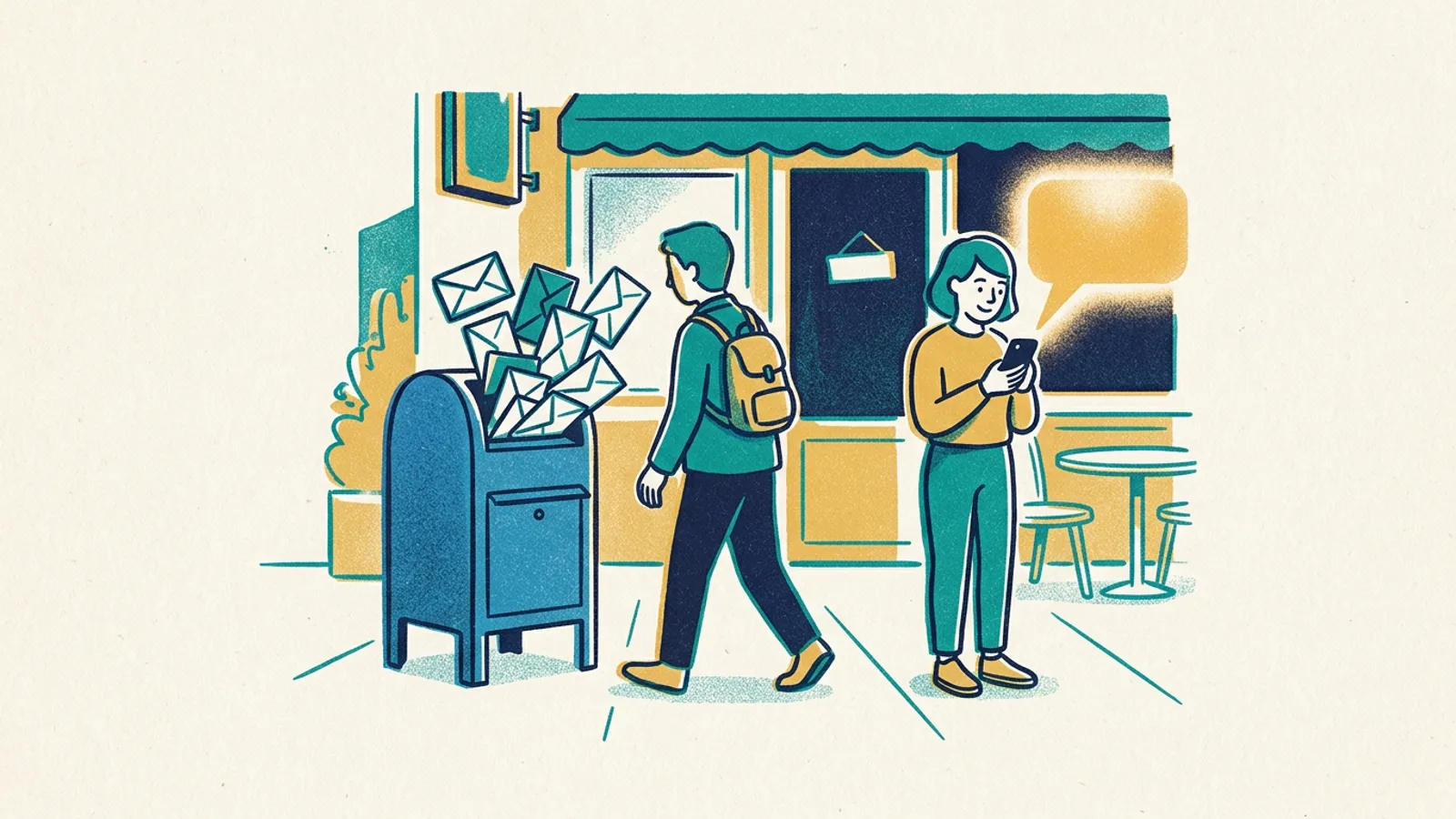
Email keeps the lookbook and the launch. The return visit belongs to the text: a reward with a dollar amount and a date on it. Mailchimp's own benchmark page puts an ecommerce email at about 30% opened and under 2% clicked. On trovy the text is the reward: five cents to send, the rest only when the customer returns.
The short version
| Email newsletter (Mailchimp, Klaviyo) | A text with a reward, on trovy | |
|---|---|---|
| Who is on the list | Whoever filled in a form or gave an address at checkout | Every customer who paid and joined by phone number at the counter |
| What the message carries | News, a lookbook, a launch | A reward with a dollar amount and a date on it |
| How many act on it | About 30% opened and under 2% clicked (Mailchimp's ecommerce benchmark, December 2023) | Not measured by opens; trovy reports the redemption, and the expiry gives the reader a reason to act now |
| What it costs | A monthly tier priced per contact, whether or not anyone opens (both vendors publish calculators) | Five cents a text when you choose to send; 2.5% of the visit where a member redeems |
| The rules | CASL: consent, identification, an unsubscribe | The same rules; consent is handled at the join |
| Best for | Launches, lookbooks and the long story | The visit this week |
What do the numbers say?
Start with email, because the vendors publish their numbers.
Mailchimp's benchmark page, last updated in December 2023, no longer breaks out restaurants or retail. Across all its users the average open rate is 35.63% and the click rate 2.62%; for ecommerce it is 29.81% and 1.74%. Klaviyo's 2026 report, drawn from more than 205,000 brands, puts campaign emails at 31% opened and 1.69% clicked, with automated flows at 32.2% and 5.58%. Its clothing and accessories category opens at 33.1% and clicks at 1.83%; food and beverage opens at 31.2%; click rates across its categories run from 1.24% to 2.03%.
Read the opens as a ceiling. An open is counted when a tracking image loads, so the click is the number to trust, and on a list of 500 a 1.7% click rate is eight or nine people. The list itself is the harder problem. A newsletter list grows by sign-up form and by the address a cashier asks for at the till, and most guests give neither.
Texts are measured differently, which is to say barely. There is no open pixel in a text message. The "98% open rate" quoted across the industry has no primary source this article could locate, so it does not use it. The closest independent evidence is a Pew Research Center methods experiment from 2016. Adding a text to an email invitation lifted same-day response from 37% to 50%, and response within 30 minutes from 6% to 15%. That is survey research, not retail, and it says one thing clearly. A text is acted on sooner.
The reach is not in question. Statistics Canada counted 93.9% of households with at least one cellphone in 2021, up from 91.3% in 2019. The number on a text is the number in the pocket of nearly everyone who walks in.
When does email still make sense?
- The lookbook and the launch. Pictures, long copy and links belong in an email. A text that tries to do that job is a wall.
- Customers who asked for it. A list that opted in to a monthly letter reads the story. Keep writing it.
- Wholesale and corporate orders. Buyers work in email, and the order history lives there.
- Small lists cost little. Klaviyo's free plan covers 250 active profiles. Both vendors' paid tiers are priced per contact and rise with the list; both publish calculators, so check the live price for your size.
What email does badly is the return visit. Nothing in a newsletter expires, so nothing in it says this week.
The rules: CASL, in plain words
Canada's anti-spam legislation applies to texts exactly as it applies to email. The Government of Canada's guidance says it in one line: "CASL is technology neutral. You must obtain consent to send commercial electronic messages, including text messages."
Consent can be express or implied. Implied consent exists "when the sender has an existing business relationship with the person to whom the message is sent." The guidance is explicit: "you may have implied consent from someone who has purchased something." That consent may be valid for up to two years (six months for an inquiry that did not become a purchase), and on the ordinary reading each new purchase starts a new window. Every message has to identify the sender and carry a working unsubscribe.
For a restaurant or a shop, the practical reading is simple. A customer who bought from you this year can be texted, as long as you say who you are and let them stop. On trovy, consent is handled at the join, when the first reward lands, so the list you build at the counter is a list you are allowed to use.
What a text with a reward does instead
Loyalty shouldn't take years. trovy treats every guest like a regular from the first visit: a reward the moment they pay, a branded text, a reason to come back. trovy works through the POS you already run. A guest pays, and seconds later a text lands: "You earned $4 at [your restaurant]. Use it on your next visit of $40 or more by November 3." Their phone number becomes a member record on your own list, with consent handled at the join. The list builds with every purchase, not with a form.
Four numbers, set once:
| Parameter | What it does | Counter, $40 ticket | Boutique, $120 basket |
|---|---|---|---|
| Earn rate | Share of the purchase that becomes a reward | 10% | 10% |
| Cap | The most one visit can earn | $5 | $15 |
| Minimum spend | What the return purchase has to reach | $40 | $100 |
| Expiry | How long the reward lasts | 30 days | 45 days |
What it costs: start for $5, everything included for your first 5 redemption visits or your first month, whichever comes first. Then you pay only on repeat sales: 2.5% of what the member spends on the visit where they redeem, after the reward comes off, plus five cents for each text you send.
A slow Tuesday, 500 members. On trovy this is Text engagement: branded texts, to the list your rewards built, sent from the dashboard. The counter sends one text: a $4 reward, usable on $40 or more, through Friday. The send costs $25. Suppose one member in twenty comes in: 25 visits at $40, with $4 off each. The restaurant collects $900 and pays about $47.50 in fees (2.5% of $36 on each visit, plus the texts). The same list by email, at the benchmark click rate, is about eight or nine clicks from whoever gave an address. The difference is not the channel. It is that the text carried a reason, with a date on it. Email asks the customer to open, read and remember. A text with a reward asks for one thing, this week, and treats them like a regular for doing it.
Related reading: Rising costs: 3 options for restaurants and shops | trovy, Is Uber Eats worth it for a Canadian restaurant? | trovy, POS loyalty add-ons vs instant rewards | trovy.
Sources
- Mailchimp, Email marketing benchmarks (updated December 2023)
- Klaviyo, Email marketing benchmarks 2026: open, click and conversion rates
- Klaviyo, How SMS and MMS pricing works (help centre, updated September 29, 2025)
- Klaviyo, Pricing
- Mailchimp, Pricing
- Government of Canada (ISED), Canada's Anti-Spam Legislation: getting consent to send email
- Government of Canada (ISED), Canada's Anti-Spam Legislation: texting and good client relations
- Pew Research Center, Text message notification for web surveys (September 7, 2016)
- Statistics Canada, Canada at a Glance 2023: Telecommunications
Frequently asked questions
Mailchimp's benchmark page, updated December 2023, no longer lists restaurants or retail; its all-user average is 35.63% opened and 2.62% clicked, and ecommerce is 29.81% and 1.74%. Klaviyo's 2026 report puts campaigns at 31% opened and 1.69% clicked, with food and beverage at 31.2% opened.
Yes, under CASL. A purchase creates implied consent for up to two years, and every text must identify the sender and carry an unsubscribe. On trovy, consent is handled when the member joins.
Klaviyo's help page says its SMS rate is account-specific and varies by country and number type, so it publishes no flat Canadian price. On trovy a text is five cents, sent only when you choose to send it.
For the return visit, yes: a text carries a reward with a date, and the independent evidence (Pew Research Center, 2016) shows a text is acted on sooner. For a launch or a lookbook, email is the better channel.
Start for $5, everything included for your first 5 redemption visits or your first month, whichever comes first. Then 2.5% of the purchase on which a member redeems, after the reward comes off, plus five cents per text. There is no setup fee and no monthly fee.
Most restaurants and shops do. Email for the story; a text with a reward for the visit this week. The list for the second one builds itself at the counter.