A sale pays everyone. A reward pays the customer who comes back: discounting vs rewarding for Canadian shops
A discount pays everyone who was buying anyway; a 20% code costs three baskets of profit on a 6% margin. The reward on trovy pays only the customer who returns.

- Published
- Reading time
- 9 minutes
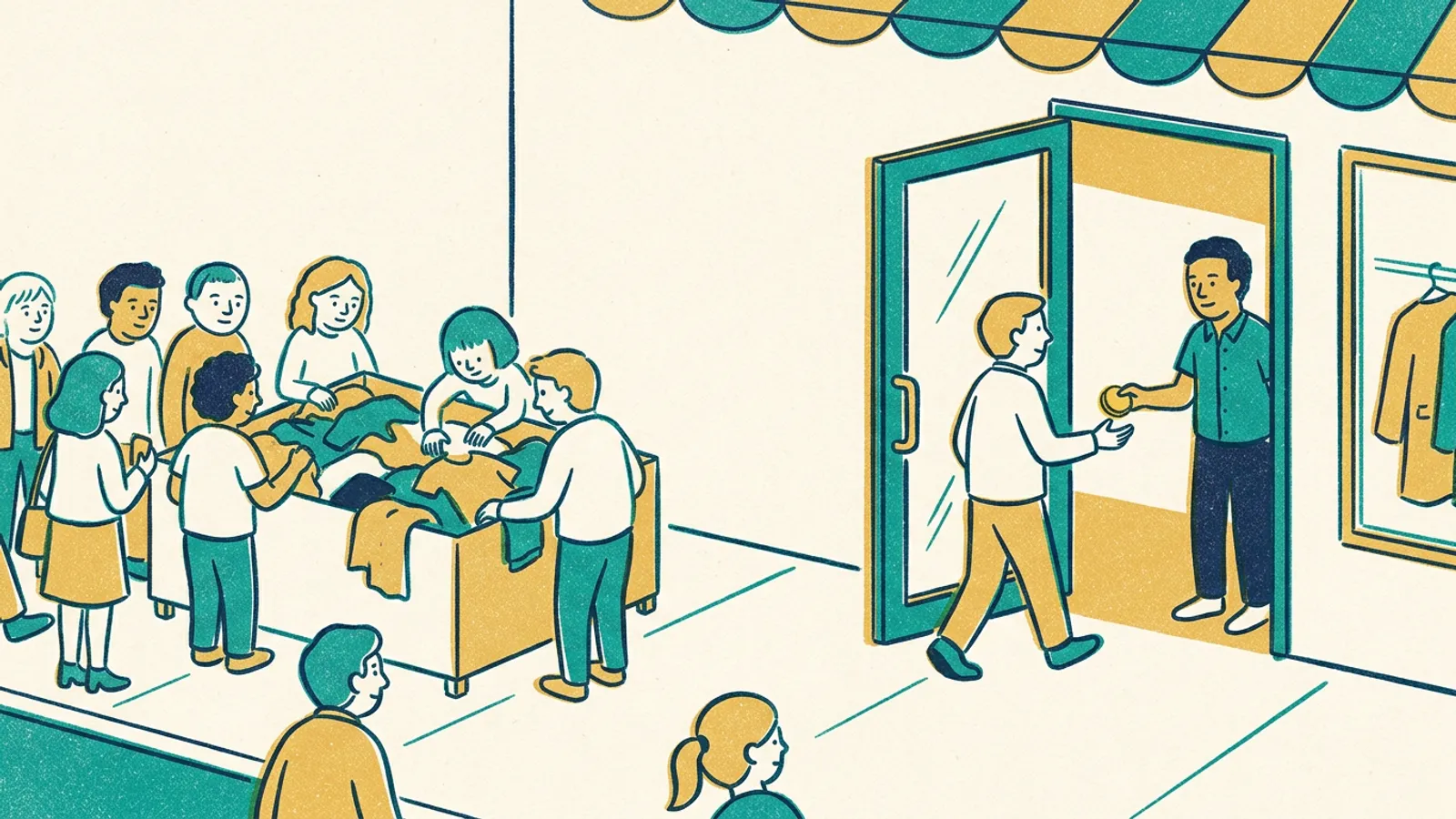
A discount pays everyone who was buying anyway and asks nothing back. A reward on trovy pays only the customer who returns, when they do. On a retail margin near 6%, a 20% code on a $60 basket hands over three baskets of profit. Keep the sale for the week it earns; pay for the second visit instead.
When a discount still makes sense
A sale is a tool. Used on a date, for a reason, it does a job nothing else does.
- Launch week. When nobody knows the shop, a first-visit offer is a cheaper introduction than most advertising, and it ends when the week does.
- Dead stock. An item that has sat through two seasons costs you shelf space every week it stays. A markdown is the right tool, and the clothing piece on markdowns covers how to run one without training the whole store to wait.
- The holiday calendar. In the Retail Council of Canada's 2025 holiday survey with Leger, of more than 2,500 shoppers, 85% said they would wait for sales before beginning to shop and 78% said they would buy discounted or promotional items. When every door on the street is on sale in November, a door that is not needs a reason the shopper can see.
- A dead week. A promotion boxed to a slow stretch, with staff already on the floor, costs margin on sales you would not otherwise have made.
The rule: a discount is an acquisition cost or a clearance cost. Spend it once, with a date on it, and let something else bring the customer back.
What does a discount really cost?
Start with the margin, not the headline. Statistics Canada's annual retail figures for 2024, released February 11, 2026, put the profit margin at 6.1% for general merchandise retailers, 6.9% for food and beverage retailers and 3.6% for motor vehicle and parts dealers. Take a $60 basket at 6.1%: $3.66 of profit.
- A 20% code. The basket drops to $48. The stock, the staff and the rent that went into it did not drop. The $12 given away is more than three baskets' worth of profit, and it went to everyone who typed the code, including the regular who was paying $60 anyway.
- Buy one, get one. Two $30 items for $30. The second item leaves without its margin, and some of those customers were buying two either way.
- A welcome discount. "10% off your first order" is $6 off the $60 basket, more than a basket and a half of profit, spent on someone who has not come back yet and may not.
The tools make the blanket version the easy one. Shopify's help pages describe discount codes and automatic discounts for a dollar amount, a percentage, buy X get Y or free shipping, with "Limit to one per customer" as the control; they list no first-order rule, so a welcome offer is either an app or honour system. At a Square register, discounts are preset percentage or dollar amounts applied by hand or automatically, and "if you apply multiple discounts to an entire sale, they'll compound"; coupon codes live in Square Online, one code per order. None of this is a flaw in the tools. It is what a discount is: a price for everyone in the window.
NielsenIQ's own research puts a number on the overlap: "nearly 50% of all promotional sales are sales that would have occurred regardless of the promotion." That is grocery data from a vendor, a direction rather than a census, and the direction is the point. Half of what the promotion paid for was coming in anyway.
And this visit is still mostly at the counter. In July 2026, Statistics Canada counted $73.7 billion in retail sales, of which $5.5 billion, or 7.5%, was e-commerce. More than nine in ten retail dollars were spent in a store.
The short version
| Promotional discount (sale, code, welcome offer, buy one get one) | Instant reward on trovy | |
|---|---|---|
| Who gets it | Everyone who buys in the window, regulars included | Only the customer who comes back and spends above your minimum |
| When you pay | On this visit, off the top | On the next visit, after the first was paid in full |
| What it asks of the customer | Nothing | A second visit, before the reward expires |
| What you learn | Little; a code is anonymous at the till | Who came back, when, and what they spent |
| What it teaches | Wait for the next one | Come back; the reward is waiting |
| Best for | Launch week, dead stock, the holiday calendar | Any customer you want to see twice |
Who does the discount train?
The research on promotions has been consistent for thirty years, and it is not about the week of the sale. It is about the weeks after.
- Shoppers learn the pattern. Mela, Gupta and Lehmann, writing in the Journal of Marketing Research in 1997, found their results "consistent with the hypotheses that consumers become more price and promotion sensitive over time because of reduced advertising and increased promotions." Every sale moves the price the customer expects.
- Deal customers mostly do not come back at full price. When daily deals were at their peak, ClickZ reported a 2011 finding from Utpal Dholakia at Rice University that "only 19.9 percent of deal users are returning for full-price purchases at restaurants, bars, salons, and other retailers." In a startup Rice profiled that year, approximately 4% of its deal buyers returned for at least a second purchase.
- Canadian shoppers now plan around the sale. The Retail Council of Canada and Leger found 85% of more than 2,500 shoppers waiting for sales before starting their holiday shopping and 80% comparing prices online. Salesforce's director of industry insights, quoted by Retail Insider in September 2026, sees spending concentrating "back into that Cyber Week period."
- They want the small reward now. The 2026 Bond Loyalty Report, from more than 9,500 Canadian consumers, found the average Canadian in 15 loyalty programs, 28% redeeming once a year or less, and 60% preferring small or medium-value rewards over saving for a large one.
Put those together and the shape is clear. A discount teaches the customer to wait for your next one. A small reward that lands right away, with a date on it, teaches them to come back before it is gone.
What instant rewards do instead
Loyalty shouldn't take years. trovy treats every customer like a regular from the first visit: a reward the moment they pay, a branded text, a reason to come back. A customer pays $60 at your counter or online, the same way they do today. Seconds later a text from your shop lands on their phone: a $6 reward, usable on their next visit, with the date it expires. They come back, give their phone number at the counter, and the $6 comes off. That is the visit you pay for.
Four numbers, set once with you before launch. A $60 shop might run:
| Lever | Setting | Why |
|---|---|---|
| Earn | 10% of the purchase | Enough to notice, small enough to protect the margin |
| Cap | $10 a visit | A big basket earns a reward, not a discount |
| Minimum spend to redeem | $60 | The return visit is a full visit |
| Expiry | 45 days | A date brings them back; an open balance never does |
What it costs: start for $5, everything included for your first 5 redemption visits or your first month, whichever comes first. Then you pay only on repeat sales: 2.5% of what the customer spends on the visit where they redeem, after the reward comes off, plus five cents for each text you send.
Run the $60 basket again on trovy's side, on standard pricing. The customer earns $6. They return and spend $60; $6 comes off; you collect $54 and pay about $1.45 (2.5% of $54, plus two texts). Against the 20% code: $12 to everyone on this visit, or $6 and $1.45 to the one customer who came back with $54.
One program at the counter and online. The same reward, the same list, on the POS you already run. The list is yours, by phone number: who came back, when, and what they spent, which no code ever told you. The sale still has its week. The second visit is yours. And the customer who makes it is treated like a regular on visit two, not visit ten.
Related reading: Markdowns vs instant rewards for clothing retailers | trovy, Discount vs reward for restaurants: the second visit | trovy, Instagram ads vs your own members: rented vs owned | trovy.
Sources
- Statistics Canada, The Daily, Annual retail trade, 2024 (February 11, 2026)
- Statistics Canada, The Daily, Retail trade, July 2026 (September 24, 2026)
- NielsenIQ, grocery trends (2025)
- Scholars@Duke, Mela, Gupta and Lehmann, The Long-Term Impact of Promotion and Advertising on Consumer Brand Choice, Journal of Marketing Research 34(2), 1997
- ClickZ, Only 20% of daily deal users come back for full-price purchases (June 17, 2011)
- Rice University News, Daily deal promotions beneficial for certain kinds of startups (May 6, 2011)
- Canadian Grocer, Canadians shop discount stores for the 2025 holiday season, Retail Council of Canada x Leger survey
- GlobeNewswire, Bond Loyalty Report 2026, Canadians are rethinking loyalty as everyday rewards take priority (May 19, 2026)
- Retail Insider, Canadian retailers enter holiday 2026 with spending momentum and price-sensitive shoppers (September 1, 2026)
- Shopify Help Center, Discounts
- Square Support, Apply discounts
Frequently asked questions
Yes, for a reason and with a date: launch week, dead stock, the holiday calendar. The cost is the margin on every sale in the window, including the ones that would have happened anyway, so box the window and end it on time.
Price it in baskets of profit, not in headline percentages. At Statistics Canada's 6.1% margin for general merchandise retailers, a 20% code on a $60 basket costs more than three baskets of profit every time it is used; a 10% welcome offer costs more than one and a half.
No. A discount is paid on this visit to everyone who buys. A reward is paid on the next visit to the customer who returns, and it expires in 30 to 60 days if they do not.
Yes. A web order earns the reward and can redeem it, the same program and the same list as the counter, on Square, Lightspeed and Shopify today, with Clover and more in progress.
Start for $5, everything included for your first 5 redemption visits or your first month, whichever comes first. Then 2.5% of the purchase on which a member redeems, after the reward comes off, plus five cents per text. There is no setup fee and no monthly fee.